
7 February 2025 · Aditi sharma
Documents Required for a Home Loan Application
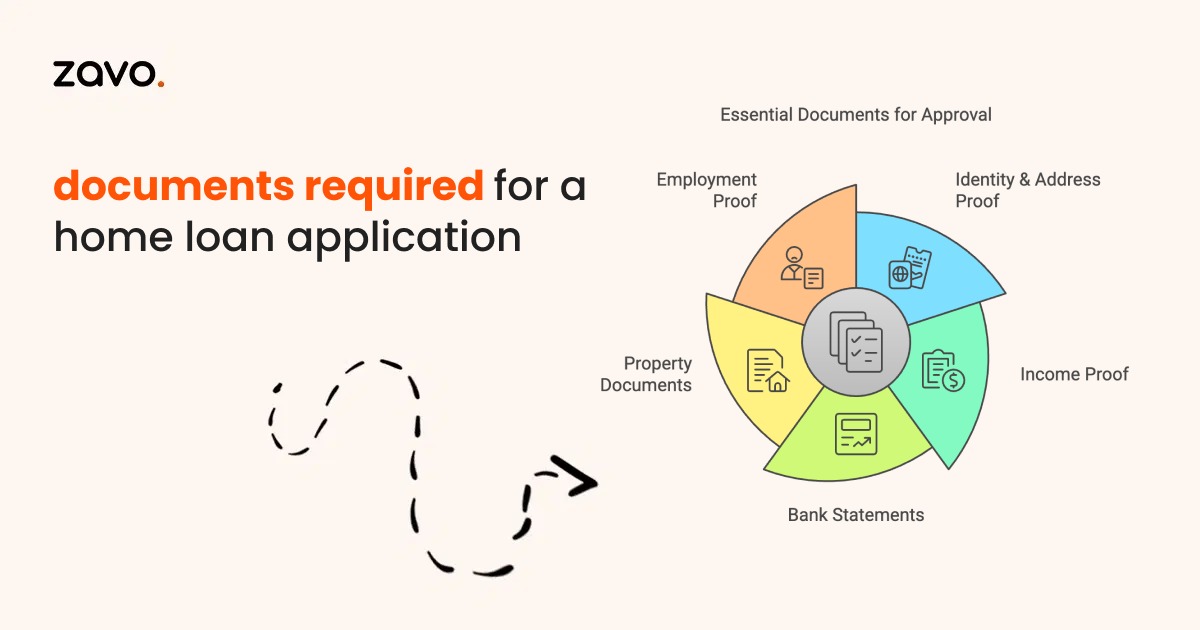
Table of contents9 sections
Applying for a home loan is an exciting step toward homeownership, but ensuring that you have the right documents ready can make the process smooth and hassle free. Banks and financial institutions require specific documents to verify your identity, income, financial stability, and property details before approving a loan.
To help you prepare, here’s a detailed list of all essential documents you’ll need when applying for a home loan.

1. Identity & Address Proof
Lenders need to verify your identity and residence to ensure you’re a genuine applicant. Any government-issued document with a photo ID and current address will work.
Documents Accepted for KYC Verification
- Aadhaar Card
- PAN Card (Mandatory for all applicants)
- Passport
- Voter ID Card
- Driving License
- Utility Bills (Electricity, Water, Gas) – Latest 3 months
- Ration Card
- Bank Passbook with Address Proof
Example: Akash applies for a home loan and submits his Aadhaar Card for identity proof and a recent electricity bill as address proof. His application is processed without delays.
Pro Tip: Ensure your address on the submitted documents matches your current residence, as mismatched addresses can cause delays.
2. Income Proof
Lenders assess your income stability before approving a home loan. The required documents depend on whether you are salaried or self-employed.
For Salaried Individuals
- Latest 3 to 6 months’ Salary Slips
- Form 16 & Income Tax Returns (ITR) – Last 2 years
- Bank Statements (Last 6-12 months) – To verify salary credits
- Employment Certificate or Offer Letter (For new employees)
For Self-Employed Individuals & Business Owners
- Income Tax Returns (ITR) – Last 3 years
- Profit & Loss Statement & Balance Sheet – Last 2-3 years
- Business Registration Certificate (GST, MSME, etc.)
- Bank Statements (Last 6-12 months) – Personal & Business Account
Example: Pooja, a self-employed fashion designer, submits her ITR for the past three years, her profit-loss statement, and business registration details. Her loan gets approved as she demonstrates consistent income.
Pro Tip: Ensure that your ITR is filed properly. Banks prefer applicants with a consistent income history over the last 2-3 years.
3. Employment Proof
Lenders prefer applicants with stable jobs or businesses, as it reduces the risk of default. You may need to provide:
- Offer Letter or Employment Certificate (For new jobs)
- Experience Certificate (If applicable)
- Company ID Card (Some banks require this for verification)
- Appointment Letter (For recent job switchers)
Example: Rahul recently switched jobs and applied for a home loan. The bank requested his appointment letter and last 3 months’ salary slips to verify his employment stability.
Pro Tip: If you’ve just changed jobs, wait for at least 6 months before applying for a home loan to show employment stability.
4. Credit Score & Financial Liabilities
Your credit score (CIBIL Score) plays a major role in loan approval. Lenders will check:
- CIBIL Report & Credit Score (Banks usually pull this themselves)
- Existing Loan Statements (If any) – Personal loans, car loans, education loans
- Credit Card Bills (Last 6 months) – If you have high usage, pay off outstanding dues before applying
Example: Neha had an outstanding personal loan of ₹5 lakh. Before applying for a home loan, she cleared the loan, which increased her credit score from 690 to 760, helping her get better loan terms.
Pro Tip: If your CIBIL score is below 700, clear existing debts to boost your score before applying.
5. Property-Related Documents
Before sanctioning a home loan, lenders verify the property’s ownership, legal status, and market value. You’ll need:
- Sale Agreement / Allotment Letter (For new properties)
- Title Deed (For Resale Properties) – To verify property ownership
- Approved Building Plan & Layout Map – To confirm legal construction
- Encumbrance Certificate (EC) – Ensures the property has no legal claims or disputes
- Possession Certificate – If buying from a builder
- NOC from Society or Builder – Required for apartments & gated communities
- Latest Property Tax Receipts – Ensures all dues are cleared
Example: Karan buys a resale flat and applies for a loan. His bank asks for the Title Deed and Encumbrance Certificate to verify that the property has no legal issues.
Pro Tip: Always double-check that the property has clear ownership before making an offer.
6. Down Payment Proof
Most lenders finance 80-90% of the property value, meaning you need to pay a 10-20% down payment upfront. You may need to provide:
- Bank Statement Showing Down Payment Transaction
- Builder/Seller Payment Receipt (For new properties)
Example: Rohit buys a ₹50 lakh apartment. He pays ₹10 lakh as a down payment and submits his bank statement and seller receipt to confirm payment.
Having a larger down payment (30% or more) increases loan approval chances and reduces EMI burden.
7. Additional Documents (Case-Specific)
Some applicants may need to provide extra documents, depending on their situation:
For NRIs (Non-Resident Indians)
- Valid Passport & Visa Copy
- Overseas Employment Proof (Offer Letter, Salary Slips, NRI Bank Statements)
- NRE/NRO Account Statement
- Power of Attorney (POA) in India
For Joint Applicants (Spouse/Parents/Siblings)
- KYC Documents for Co-Applicant
- Income Proof for Co-Borrower (If income is considered for eligibility)
Example: An NRI applicant, Sameer, provides his overseas salary slips and Indian Power of Attorney document to process his home loan while living in the US.
If you’re an NRI applicant, check with your lender for specific document requirements.
Final Thoughts
Having the right documents ready makes the home loan process quicker and smoother. Whether you’re a salaried employee, self employed professional, or an NRI, preparing your KYC, income proof, property documents, and financial statements in advance reduces delays and improves approval chances.
Looking for a quick and easy loan? Let zavo help you!
✔️ Instant Loan
✔️ Competitive Interest Rates
✔️ Quick Processing with Minimal Documentation
Frequently Asked Questions (FAQs)
1. Do I need a co-applicant for a home loan?
No, but adding a spouse or parent as a co-applicant can increase your loan eligibility.
2. What documents are needed for a home loan if I’m self-employed?
You need 3 years of ITR, profit-loss statements, business registration proof, and bank statements.
3. How much down payment do I need for a home loan?
Most banks require a 10-20% down payment, but a higher amount improves approval chances.
4. Can I apply for a home loan without an ITR?
No, lenders require ITR for income verification, especially for self-employed applicants.
5. How long does it take to process a home loan?
If all documents are in order, approval can take 7-15 days.